
Women's
Technology Program
in
Electrical Engineering & Computer
Science
Massachusetts Institute of Technology
WTP-EECS
Application
Calendar
FAQ
Residential
Resources
Sponsors
WTP-Home
WTP-ME
Contact
Us

The Electrical Engineering and Computer Science (EECS) track of the Women's Technology program was offered from 2002 - 2022. The program has been on hiatus since the retirement of long time WTP Director and EECS Track Coordinator, Cynthia Skier.
Information below from the Summer, 2022 WTP-EECS Program
WTP-EECS coursework will cover introductions to Electrical Engineering and Computer Science, designed for students with NO prior background in either topic.
f*************************************************************************
The WTP-EECS curriculum introduces students to computer science and electrical engineering.. Classes are very fast-paced, but are designed for students with no prior engineering or computer science exposure.
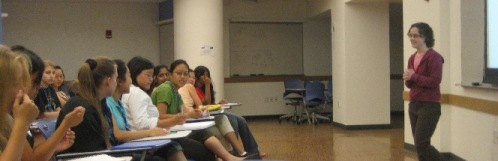
WTP-EECS has a collaborative culture, whether the format is virtual or residential. Coursework and projects are done in teams, with an emphasis on developing multiple ways to approach and solve problems. Brainstorming, learning from mistakes, sharing ideas, and debugging (circuits and code) are important features of the WTP-EECS learning process.
For a description of the WTP Mechanical Engineering Curriculum visit the WTP-ME Track.
The WTP-EECS classes are taught by graduate students from the MIT Department of Electrical Engineering and Computer Science, assisted by MIT or Wellesley undergraduate students. WTP is not a certified academic program, you are not enrolled as an MIT student, and you do not receive college credit. WTP is not an internship (you are not doing research, you cannot receive summer internship credit).
We expect WTP students to to be excited about the joy of learning engineering and computer science and to work as hard on their classes as they would if they were earning credit.
Below is a general description of the curriculum. Projects and some topics may vary, as we are still developing the 2022 curriculum.
WTP-EECS Classes
 Computer Science
The computer science curriculum is a fast-paced introduction to thinking computationally and programming in Python. The course is designed for students with no prior CS experience, but moves very quickly to cover fundamental topics such as data types, lists, loops, functions, and objects. Students complete challenging conceptual exercises and daily programming assignments, with an extensive final project. If WTP is virtual we will ship loaner laptops to students loaded with the software they need; if we are residential on campus they will use MIT lab computers.
 Electrical Engineering
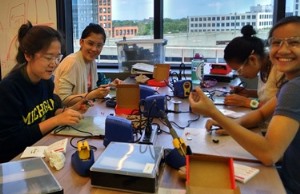
The EE curriculum introduces fundamental electronics through short lectures, readings, homework, and hands-on projects, with emphasis on experimentation, design, and troubleshooting. If WTP is virtual we will send students materials, components, and equipment that will allow them to build and test projects at home. If WTP is residential the EE class will be taught in an MIT lab setting.
Physics of Energy and Motors
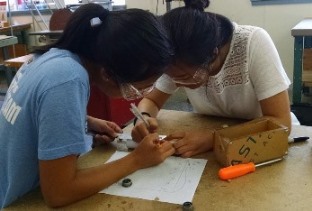
Students will explore topics in energy, motors, and power through a series lectures and projects they build.
Guest Speakers
MIT faculty and engineers from industry will present information
about their research and career paths several
days each week, so students can see some real-world problems people are currently solving using engineering and computer science.
Please note: all photos on this page are from previous years when WTP was in-person on the MIT campus, and do not reflect what 2022 classes will look like.
Recommended Background for WTP-EECS Students
Students admitted to WTP should have no prior experience (or very little) with engineering or computer science, but they must be able to handle very fast-paced college-level math and science, and be interested in hands-on collaborative team-based learning and projects. We will not admit students who have already covered our curriculum in their high school classes, after school activities, online courses, or other summer programs or internships.
For more information about who should apply to WTP and the admissions criteria, visit our Application page.
Note that the WTP-EECS computer science class is introductory, and designed for students with little or no prior background in coding. Check our FAQ about CS Background to determine if you have too much computer programming background to be considered for the WTP-EECS curriculum track.